GEO Best Practices: Prompt Volume Shouldn’t Drive Your Strategy

Most recommendation on generative engine optimization greatest practices begins in the identical place: discover the prompts persons are utilizing with AI instruments, observe which of them give your model visibility, and construct content material across the highest-volume queries.
The issue? That information is basically estimated.
Generative engine optimization (GEO) remains to be new sufficient that the infrastructure to measure it precisely doesn’t exist but. Consider how GEO differs from SEO: the mature, dependable indicators you’ve come to count on from instruments like Semrush or Ahrefs took years to develop. GEO measurement isn’t there but. What platforms name “immediate quantity” is modeled, estimated, and sometimes directionally flawed.
This submit breaks down why immediate quantity is an unreliable basis in your GEO technique and what the best-performing groups do as a substitute.
Key Takeaways
- “Immediate quantity” is a modeled estimate, not precise consumer information, making it an unreliable place to begin for GEO selections.
- AI conduct is inconsistent; folks phrase prompts in a different way and fashions return diversified solutions, making patterns exhausting to belief at small scale.
- AI “rankings” are unstable; research present outcomes change consistently, so monitoring place the best way you observe web optimization doesn’t translate.
- Most information sources, whether or not panels or APIs, are biased or don’t replicate actual consumer conduct in AI instruments.
- Quotation drift is excessive, which means sources and visibility shift month to month even for equivalent prompts.
- GEO instruments are nonetheless early and directional, not definitive; deal with them accordingly.
- Clustering prompts round your ICP’s precise language outperforms chasing vendor-curated question lists.
- A constant monitoring schedule issues greater than obsessing over any single information level.
Why Immediate Quantity Misleads Your GEO Technique
1. LLMs Don’t Have Search Quantity: It’s Estimated, Not Measured
Essentially the most basic drawback is that there isn’t a true “AI search quantity” the best way Google exposes search question information. LLMs don’t publish question frequency or search quantity equivalents. Their responses range, generally subtly and generally dramatically, even for equivalent queries, because of probabilistic decoding and immediate context. Additionally they rely upon hidden contextual options like consumer historical past, session state, and embeddings which might be opaque to exterior observers. What platforms promote as “immediate quantity” is a modeled estimate, not a direct measurement.
2. LLM Responses Are Non-Deterministic by Nature
Conventional key phrase quantity works as a result of thousands and thousands of individuals kind the identical phrase into Google and people queries are logged. AI interactions are essentially completely different. Search conduct in conventional web optimization is repetitive, with thousands and thousands of equivalent phrases driving secure quantity metrics. LLM interactions are conversational and variable. Folks rephrase questions in a different way, typically inside a single session, making sample recognition tougher with small datasets.
This non-determinism is baked into how LLMs work. They produce textual content utilizing probabilistic strategies, choosing phrases based mostly on their probability moderately than following a set sample. The identical immediate can produce completely different responses, which makes constant and correct conclusions tough to attract.
3. SparkToro’s Analysis Exhibits Rankings Are Basically Random
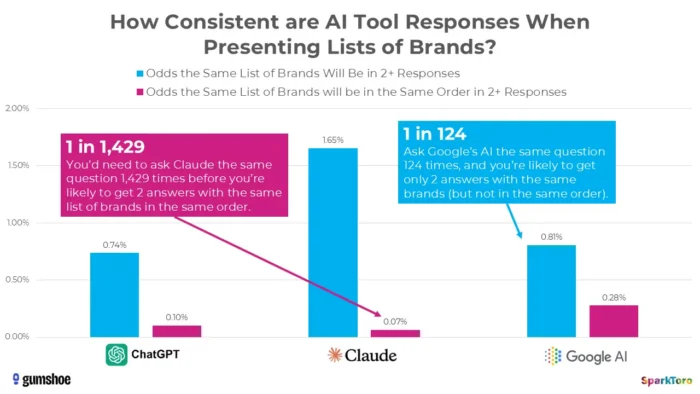
Essentially the most compelling proof comes from a landmark January 2026 examine by Rand Fishkin and Gumshoe.ai. They examined 2,961 prompts throughout 600 volunteers on ChatGPT, Claude, and Google AI. The discovering: there may be lower than a one in 100 probability of getting the identical model listing in any two responses, and fewer than one in 1,000 probability of the identical listing in the identical order. As Fishkin bluntly concluded, any instrument that provides a “rating place in AI” is actually making it up.
Analysis from SparkToro highlights vital variability in AI-generated model suggestions even when equivalent prompts are used, suggesting that point-in-time AI visibility measurements could replicate volatility moderately than sturdy efficiency indicators.
4. Panel-Based mostly Methodology Has Inherent Bias Issues
Platforms like Profound depend on opt-in shopper panels to supply their immediate information. Profound licenses conversations from a number of, double opt-in shopper panels of actual reply engine customers, with scale within the lots of of thousands and thousands of prompts monthly, and applies superior probabilistic modeling to extrapolate frequency, intent, and sentiment throughout broader populations.
Whereas this sounds strong, the opt-in nature of those panels means the pattern could skew towards extra tech-savvy, engaged customers, not a consultant cross-section of how the final inhabitants really prompts AI instruments.
5. API Queries Don’t Mirror Actual Human Habits
Many instruments question AI fashions through API to simulate consumer prompts, however this introduces one other hole. Most AI monitoring instruments depend on API calls moderately than mimicking human interface utilization, and early analysis suggests API outcomes could differ from interface outcomes, although the magnitude and implications of those variations require additional investigation. The API-focused nature of querying information additionally implies that outcomes usually are not aligned with what people really seek for.
6. Quotation Drift Is Large and Unpredictable
Even in case you ignore all the pieces above, the month-to-month stability of AI citations is shockingly low. A examine by Profound measured quotation drift month over month and noticed very giant adjustments in cited domains even for equivalent prompts. Google AI Overviews and ChatGPT confirmed month-to-month variations of dozens of share factors.
This implies the “quantity” hooked up to any given immediate in the present day could look utterly completely different subsequent month, making it an unreliable basis for content material funding selections.
7. We’re in a Pre-Semrush Period: The Instruments Don’t But Have the Infrastructure
We’re nonetheless in a pre-Semrush/Moz/Ahrefs period for LLMs. No person has full visibility into LLM influence on their enterprise in the present day. Be cautious of any vendor or marketing consultant promising full visibility, as a result of that merely isn’t attainable but. Present monitoring information needs to be handled as directional and helpful for selections, however not definitive.
Generative Engine Optimization Finest Practices: What to Do As an alternative
Immediate quantity is one sign amongst many, and proper now it’s one of many weaker ones. Listed here are the generative engine optimization greatest practices that truly maintain up.
Begin With Your ICP, Not a Dashboard
Relatively than letting estimated immediate quantity dictate your GEO content material priorities, begin with what you really learn about your viewers. The strongest sign you’ve got is your Supreme Buyer Profile. What issues are your greatest clients hiring you to resolve? What language do they use to explain these issues? These ache factors, not a vendor’s modeled immediate estimates, needs to be the muse of what you optimize for in AI solutions.
Supply: The Smarketers
In the event you’ve carried out strong ICP work, you’re already sitting on higher information than any immediate quantity instrument can provide you.
Go The place Your Viewers Already Talks
Layer in actual viewers analysis by going the place your viewers speaks brazenly and actually. Reddit threads, area of interest boards, LinkedIn feedback, Slack communities, and assessment websites like G2 and Trustpilot are locations the place folks ask unfiltered questions in their very own phrases. That’s precisely the sort of pure language that maps intently to how somebody would immediate an AI instrument. In case your ICP is repeatedly asking “how do I justify the ROI of X to my CFO” in a subreddit, that’s a much more dependable content material temporary than a immediate quantity quantity hooked up to a vendor-curated question.
Mine Your Personal Buyer Conversations
Buyer-facing groups are some of the underused sources of GEO intelligence. Gross sales name recordings, assist tickets, buyer interviews, and onboarding conversations are wealthy with the precise phrasing actual patrons use after they’re caught, skeptical, or evaluating choices. That language belongs in your content material and in the end in AI solutions. In case your gross sales workforce hears the identical objection each week, there’s a very good probability somebody is asking an AI the identical query.
Cluster and Manage Prompts Round Your Viewers’s Language
After you have uncooked enter out of your ICP work, boards, and buyer conversations, the following step is structuring it. Relatively than treating every potential immediate as an remoted goal, group them by intent and theme.
Immediate clustering round comparable subjects or ache factors helps you see patterns in how your viewers thinks about an issue, not simply how they phrase a single query. A cluster round “the best way to measure GEO success” may embody prompts about metrics, reporting, stakeholder communication, and benchmarking. Every of these deserves content material, and the overlap between them tells you what your core narrative needs to be.
This can be a significant shift from key phrase analysis logic. Once you’re enthusiastic about GEO versus AEO, the organizing precept stays the identical: topical authority across the issues your viewers is making an attempt to resolve. Immediate group by intent and theme is what enables you to construct that authority systematically.
Use Immediate Quantity Instruments for What They’re Truly Good At
None of this implies abandoning platforms like Profound or Writesonic solely. Used appropriately, they’re genuinely helpful for directional consciousness: recognizing subject gaps, monitoring whether or not your model is showing in the appropriate conversations, and monitoring share of voice towards opponents over time.
The error is utilizing them as a key phrase quantity substitute and letting their estimates drive what you create. Let your ICP, viewers analysis, and actual buyer conversations inform you what to optimize for. Then use immediate quantity information to pressure-test and monitor, to not resolve.
Construct a Monitoring Schedule That Truly Works
Given how a lot quotation drift exists in AI outputs, monitoring must be structured and constant moderately than reactive. Checking your model’s AI visibility as soon as 1 / 4 isn’t sufficient. A month-to-month monitoring schedule in your core immediate clusters provides you an affordable baseline for recognizing significant shifts with out over-indexing on noise.
Right here’s the best way to strategy it virtually. Arrange an outlined listing of 20 to 30 prompts that replicate your ICP’s commonest questions. Run them on a set cadence, at the least month-to-month, throughout the platforms your viewers makes use of most, equivalent to ChatGPT, Perplexity, and Google AI Overviews. Monitor whether or not your model, your content material, or your opponents are showing. Be aware adjustments, however don’t overreact to single-month swings given how a lot variation exists. What you’re expecting is directional developments over three to 6 months, not week-to-week positions.
That is what separates groups with an actual AI search optimization technique from these reacting to dashboard alerts. Monitoring informs; it doesn’t resolve.
The Backside Line
Immediate quantity tries to approximate demand that you could be have already got direct entry to. The manufacturers that win in AI search aren’t those chasing the most-tracked prompts. They’re those who perceive their viewers deeply sufficient to indicate up within the solutions their clients are literally on the lookout for.