How to Create a Wikipedia Page for Your Company

Wikipedia is an enchanting experiment. It’s a community-built encyclopedia that’s all the time in movement. It runs on volunteer vitality and brazenly shared infrastructure, and it’s nearer to an open-source mission in how it’s constructed than a standard encyclopedia guide. Anybody can write, edit, and debate what belongs on a web page.
And that’s the twist. The “reality” on Wikipedia isn’t handed down by a single editor or group member. It’s negotiated in public, guided by group requirements, citations, and a complete lot of dialog. Contributors don’t a lot management a topic’s story as they regularly check it. They’re consistently asking questions: What can we confirm? What deserves weight? What’s lacking?
Once you learn a Wikipedia article, you’re seeing a present snapshot of a residing, evolving group resolution.
This entire experiment has scale, too. As of February 6, 2026, the English Wikipedia had 7.13 million articles, and the mission spanned greater than 340 languages.
When you’re interested by making a Wikipedia web page to your firm, it helps to know what you’re signing up for. Wikipedia isn’t a advertising channel, and it isn’t designed for firms to form their narrative.
It’s designed to summarize what unbiased, dependable sources have already mentioned about an organization, so not each group qualifies for a stand-alone article. Wikipedia cautions that only a small percentage of organizations meet the requirements for an article within the first place.
The simplest technique to orient your self with the platform is to maintain Wikipedia’s “five pillars” prime of thoughts. Wikipedia is, at the beginning, an encyclopedia. It goals for a impartial standpoint, the content material is free for anybody to make use of and edit, editors are anticipated to be civil, and there aren’t any hard-and-fast guidelines. It’s simply insurance policies and tips utilized with unbiased judgment.
If your organization is genuinely notable by Wikipedia’s requirements and also you’re prepared to play by its tips, there’s an actual visibility upside in a stable, well-sourced web page that holds up over time.
Key Takeaways
- Wikipedia isn’t for advertising. If a Wikipedia web page reads like firm positioning, a function brochure, or a pricing web page, it’ll get rejected, reverted, or flagged. Even when different firm pages “get away with it,” you should give attention to making a deeply researched, informative draft to present robust notability in Wikipedia’s eyes.
- Notability = unbiased protection. You want a number of robust secondary sources (actual reporting with editorial requirements). Press releases, paid placements, area of interest commerce mentions, and contributor “interviews” don’t maintain up.
- Sources drive the define (and the web page). Construct your define from what your credible secondary sources already cowl. Attainable sections might embrace a lead, historical past, high-level operations, management, or controversies, if documented. Every firm’s define might look totally different relying on what data will be strongly sourced. When you can’t supply a piece cleanly, it doesn’t belong.
- Use Wikipedia’s Articles for Creation (AfC) course of to keep away from battle of curiosity (COI) roadblocks. When you’re linked to an organization or paid to jot down a Wikipedia web page for them, you will need to disclose it and lean on the AfC course of as a substitute of immediately pushing an organization web page stay.
- Getting revealed isn’t the end line. Volunteers repeatedly evaluate pages. Anticipate ongoing edits, scrutiny, and occasional challenges, so monitor a stay web page and hold it up to date with robust, unbiased citations.
What Are the Advantages of Making a Wikipedia Web page?
Essentially the most vital advantage of Wikipedia is its sheer dimension and attain. It is among the most visited web sites on the planet, averaging greater than 1.1 billion unique visitors per month.
Along with the dimensions of its viewers, the platform gives different advantages to entrepreneurs and firm house owners:
- Credibility through unbiased validation (earned, not claimed): A stay Wikipedia web page alerts that dependable, third-party sources have lined your group in a significant approach. For journalists, companions, buyers, and enterprise patrons, this may cut back skepticism throughout analysis.
- Search and AI visibility (off-page, long-term): Wikipedia tends to floor prominently in search outcomes and is usually referenced by information programs. A well-sourced web page can assist progress in how your organization seems in search options, AI overviews (AIOs), and huge language mannequin (LLM) output, based mostly on what unbiased sources say, not what an organization needs to say.
- A impartial orientation web page for readers: Wikipedia’s format helps readers shortly perceive an organization’s fundamentals, together with historical past, services or products, management, milestones, and context. The tradeoff is accessible neutrality. Something included wants assist from dependable secondary sources, and promotional language hardly ever lasts.
- Readability and disambiguation: In case your title overlaps with different firms, or your story contains mergers, rebrands, or a number of founders, Wikipedia will help individuals land on the suitable entity and timeline.
- A sturdy reference hub: Wikipedia web page typically turns into a secure listing of the strongest unbiased sources about you, similar to press, books, and different respected protection, so readers can confirm particulars with out relying in your web site alone.
- Consistency throughout the net (a quiet multiplier): Wikipedia and associated information sources are reused in lots of downstream locations. When the information are clear, cited, and constant, it could possibly enhance how your organization is represented throughout third-party profiles and knowledge panels over time.
A Wikipedia web page is never a conversion engine, and it isn’t a spot to “personal” your story. The worth is credibility and discoverability that may compound, however advantages can fluctuate based mostly on the energy of unbiased protection and ongoing group scrutiny.
Beneath, we’ll cowl the ten steps on how you can create a Wikipedia web page, in addition to concerns to remember.
1. Test to See If Your Firm is a Good Match for a Wikipedia Web page
Earlier than you concentrate on how you can create a Wikipedia web page to your firm, you should reply one query:
Would Wikipedia editors take into account your organization “notable”?
On Wikipedia, “notability” has nothing to do with how compelling your organization story is. It means there’s sufficient unbiased, dependable protection about your organization that an article will be written from what third events have already revealed, with out filling in gaps with interpretation, insider information, or advertising claims.
That is additionally the place a number of model groups get tripped up. Once more, Wikipedia isn’t a advertising channel. It’s not a spot to form messaging or management a story. If the one story you may inform is the one you need to inform, the web page shall be declined throughout preliminary submission evaluate or deleted later.
What Notability Really Appears Like
An organization is often thought-about notable when it receives vital protection in a number of dependable sources unbiased of the corporate. “Vital protection” is the important thing phrase right here. Editors are searching for articles that debate your organization in actual depth, not fast mentions or brief blurbs.
A useful approach to consider it’s this: for those who can’t define a impartial article utilizing unbiased secondary sources alone, you most likely don’t have sufficient notability but.
Editors usually need protection that checks these packing containers:
- Unbiased: Really third-party reporting. Not press releases, paid placements, sponsored posts, advertorials, associate blogs, or content material your PR group organized. If a chunk exists as a result of the corporate made it occur, editors are inclined to low cost it.
- Vital: Greater than a passing point out. A funding announcement, product launch blurb, or occasion itemizing will be actual protection and nonetheless not be sufficient. The strongest sources are those that designate context, influence, historical past, or controversy intimately.
- Secondary: Sources that analyze, summarize, or report on the corporate from the skin. Major sources like your web site, weblog, press web page, or social channels can assist primary information in restricted instances, however they don’t set up notability.
- Dependable: Publications with editorial oversight and a popularity for accuracy. Large-name shops will help, however they aren’t the one choice. Commerce and {industry} publications will be glorious sources once they have actual editorial requirements and supply in-depth protection, however you may hardly ever use them to ascertain notability.
- A number of and sustained: A single nice supply is never sufficient by itself. Editors need to see multiple robust supply, ideally throughout time, so the web page can maintain up after extra individuals evaluate it.
- Impartial tone: Even when a supply is unbiased, it could possibly nonetheless be weak if it reads like promotion. Glowing profiles, “thought management” posts, or contributor content material that appears like advertising typically carry much less weight than staff-reported protection.
One nuance that issues so much in observe is that “numerous hyperlinks” doesn’t equal notability. Firms can seem everywhere in the web by means of routine bulletins and PR-driven writeups and nonetheless fail Wikipedia’s notability check.
What issues is whether or not unbiased sources have handled the corporate as worthy of actual, substantive protection. This additionally implies that magazines and commerce publications can’t work as dependable protection to ascertain notability. Many {industry} leaders additionally run commerce organizations, making a battle of curiosity (COI, in Wikipedia’s phrases) if their commerce publication have been to cowl their very own firm or the businesses of mates or contributors.
If your organization doesn’t meet this bar but, that’s not a judgment on it. It simply means a Wikipedia article is probably going untimely, and the higher transfer is to attend till there’s sufficient unbiased protection to assist a impartial, well-sourced web page.
A Be aware on Battle of Curiosity (COI)
When you’re writing about your individual firm (otherwise you’re paid to jot down for an organization), Wikipedia considers {that a} conflict of interest (COI). That doesn’t mechanically ban you from collaborating, but it surely does change how it’s best to method it.
When creating a brand new web page, submit it to Articles for Creation (AfC) to make sure group editors evaluate it correctly.
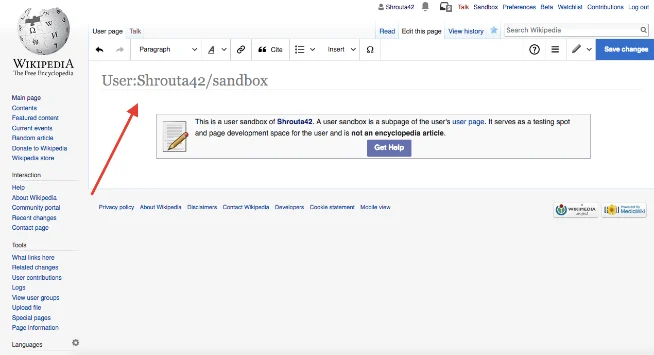
When enhancing an current web page, you need to create your edits in a Sandbox draft (the Sandbox is a private workspace the place you may safely draft and refine adjustments to an article earlier than submitting them for public evaluate). Then, you submit that Sandbox draft onto the stay Wikipedia web page’s Talk page, together with a remark that asks group members to evaluate and collaborate on the edits you prompt. As soon as a group consensus is reached, you may push these edits or additions stay.
Supply: https://courses.shroutdocs.org/tutorials/editing-your-wikipedia-sandbox/
It’s additionally a good suggestion to reveal your COI connection. Your disclosure must be one of many following:
- An announcement in your Consumer web page.
- An announcement on the Speak web page accompanying any paid contributions.
- An announcement within the edit abstract accompanying any paid contributions.
Keep away from immediately creating or closely enhancing an article and persist with Wikipedia’s COI course of to request edits for unbiased editors to evaluate.
Once more, that is about expectations. In case your group is hoping to only write a draft and hit “publish,” such as you do with a weblog, you’re going to have a foul time. However for those who do have robust, unbiased protection from credible shops, you’ve acquired an actual shot and might transfer to the subsequent step.
2. Create a Wikipedia Account
Creating an account is a sensible subsequent step for those who plan to contribute to Wikipedia. Whilst you don’t want an account to learn Wikipedia (and even to edit some pages), registering provides you options that make collaboration and transparency simpler.
With an account, you may:
- Create a User page (a easy profile and a spot to draft in a Sandbox).
- Use your Speak web page to speak with different editors.
- Construct an edit historical past tied to your username (useful for credibility and continuity).
- Work by means of article creation extra easily, together with drafting and submitting through AfC.
When you add images to your User page, be sure they’re correctly licensed. Wikipedia typically accepts solely freely licensed uploads.
To register, use Wikipedia’s account creation form.
After that, you’re set as much as begin enhancing, drafting, and collaborating in the neighborhood.
3. Contribute to Current Pages
Fast reminder from earlier: When you’re linked to the corporate, you’re coping with a COI. That’s why Wikipedia prefers that firm pages endure unbiased evaluate earlier than publication.
As a beginner, a great way to get comfy on Wikipedia is to begin by enhancing current articles that don’t have anything to do along with your group. Once you spend time bettering readability, tightening wording, and backing up information with stable sources, you find out how Wikipedia works, and also you construct a historical past of useful contributions.
As you do this, your account might change into autoconfirmed. That often occurs mechanically after your account has been round for greater than 4 days and also you’ve made not less than 10 edits to Wikipedia pages that want them. Autoconfirmed standing primarily grants a number of primary permissions, similar to creating pages and enhancing some semi-protected articles.
Right here’s the important thing level, although: “Autoconfirmed” doesn’t change your COI scenario. Even for those who can technically publish a web page immediately, a company-related article ought to nonetheless be written as a draft and submitted by means of AfC. That is the step that will get you the unbiased evaluate Wikipedia expects, and it’s the most secure, most applicable route for an organization web page.
4. Conduct Analysis and Collect Sources
Earlier than you write a single line of your Wikipedia draft, do the homework. Wikipedia doesn’t prioritize non-source-backed storytelling. The platform solely cares about verifiability, that means each significant declare should be backed by a dependable secondary supply that an editor can test. Your organization story might play effectively on Wikipedia, so long as there’s sufficient dependable proof to again it up.
That is the place most firm pages collapse. Not as a result of the corporate isn’t actual, however as a result of the sources are skinny, biased, or too “inside baseball.”
Why sources matter a lot on Wikipedia
Wikipedia runs on two massive guidelines:
- No unique analysis: You’ll be able to’t “introduce” new information, even when they’re true, with out correct quotation. Which ends up in the subsequent level…
- Cite all the things that issues: If it’s notable, controversial, or particular (income, awards, historical past, key dates, acquisitions), you want a secondary supply to again it up.
Major vs. secondary vs. tertiary sources (and the way Wikipedia treats them)
Wikipedia breaks sources down into three classes: major, secondary, and tertiary. Here’s a have a look at every and the way they play into the energy of your Wiki web page:
- Major sources (you): Your web site, press releases, investor decks, revealed reviews, filings (e.g., Securities Trade Fee (SEC), and so forth.).
- Upside: Can work for primary, factual particulars (launch dates, historic milestones, and so forth.).
- Draw back: Biased by default. Editors gained’t settle for these for “notability” or massive claims like “{industry} chief.”
- Secondary sources (greatest for Wikipedia): Unbiased journalism, books, educational evaluation, respected profiles.
- Upside: Reveals the world observed you. That is the spine of the strongest pages.
- Draw back: More durable to earn, and fluff items don’t carry a lot weight.
- Tertiary sources: Encyclopedias, databases, respected directories.
- Upside: Helpful for fast affirmation and context.
- Draw back: Typically too shallow to show notability on their very own.
General, secondary sources are the most necessary to your success. By their nature, these sources are pivotal in serving to you summarize what specialists take into consideration an organization or matter in Wikipedia’s voice. Relying closely on these provides you a very robust case for notability in Wikipedia’s eyes.
What Makes a Good Wikipedia Supply?
Good Wikipedia sources cowl matters whereas sustaining editorial requirements. Assume main publications, native newspapers of document, revered enterprise shops, and unbiased {industry} evaluation. When you’re brief on that sort of protection, that’s often a PR drawback, not a Wikipedia drawback. Strengthening your digital PR (DPR) efforts will help you earn credible mentions that maintain up beneath editor scrutiny.
However DPR for a Wikipedia use case should be dealt with rigorously. What tends to work is specializing in unbiased protection first. This seems to be like pitching credible story angles to journalists and shops that genuinely cowl your {industry}, and accepting that they might say no, or cowl the story in a approach you may’t management.
When an outlet does publish actual, editorial reporting, that’s the sort of secondary supply Wikipedia editors usually tend to settle for.
Dependable Sources at a Look
After seeing what Wiki editors take into account reliable sources, you is likely to be questioning the place you even discover sources that hit all their standards. It helps to have a look at real-world use instances of which sources are greatest to your firm. Listed here are among the kinds of websites you may select from.
For firm pages, the sources that matter most are those that present vital, unbiased protection; the type that demonstrates notability and offers editors one thing substantial to quote.
- Main nationwide/worldwide newsrooms (strongest for notability + information): Reuters, AP, BBC, Monetary Occasions, The Wall Road Journal, Bloomberg, The New York Occasions, The Washington Submit, NPR (information reporting over opinion).
- Respected enterprise and investigative reporting: Deep dives and investigations from established shops (e.g., ProPublica) will be extremely beneficial, particularly for controversies, authorized points, and accountability reporting.
- Excessive-quality commerce press with editorial oversight (context-dependent): Helpful for {industry} protection when it’s unbiased and greater than a product announcement or reposted PR. You can’t use commerce press as a major indicator of notability, although.
- Books from respected publishers: Particularly useful for founders, firm historical past, and {industry} influence when written by unbiased authors and revealed by established presses.
- Authorities and main non-governmental group (NGO) reviews (inside remit): Sturdy for regulatory actions, enforcement, public contracts, or formal assessments (however not an alternative choice to unbiased secondary protection).
- Medical/well being claims (solely when related): For biomedical statements, prioritize high-quality secondary sources like systematic evaluations and authoritative tips (MEDRS standard), not particular person research or advertising claims.
Try Wikipedia’s Perennial Sources list to see which sources have a great group observe document as a result of all of them meet a excessive degree of fact-checking and editorial requirements. However bear in mind, the sources featured on this record are nonetheless contextual; it’s not a whitelist.
Non-reliable Sources
To color a clearer image, listed below are among the sources it’s best to keep away from:
- Self-published/user-generated content material (UGC): Private blogs, Substack/Medium posts, self-hosted websites, most social media.
- Press releases/advertorial: Firm press rooms, PR wires; these are high quality to state that an announcement occurred, to not set up third-party information or notability.
- Sensational/tabloid sources: Retailers identified for gossip/sensationalism; poor for verifying information.
- Nameless boards and crowdsourced threads: Message boards, remark sections, most Reddit/4chan/Discord posts.
Wikipedia views a majority of these sources as weaker as a result of they aren’t research-backed, reliable, or credible. The frequent thread is that they endure minimal editorial oversight (if any) or, in Reddit’s case, a lot of the content material is UGC and self-published.
5. Analysis Your Competitors
Like many issues relating to Wikipedia, researching your rivals is ok for those who do it the suitable approach. As you begin your analysis, view your rivals’ pages by means of the lens of what Wikipedia editors in the end need.
The problem right here is that Wikipedia isn’t completely constant. Some firm pages are previous, frivolously monitored, or haven’t been up to date to match at this time’s requirements.
When somebody says, “However different pages embrace function lists and product tier breakdowns,” that doesn’t actually matter. Editors don’t deal with “other pages do it” as a justification. They choose your web page on whether or not it reads like an encyclopedia entry and whether or not it’s backed by unbiased, dependable sources.
Normal Competitor Analysis Guidelines
Use competing Wiki pages to reply questions like:
- What’s the standard construction for an organization web page in your class? Be aware of the standard part titles. (We’ll dive into this subsequent.)
- What sort of claims survive with out getting reverted? (Impartial, sourced, non-promotional.)
- What sources are doing the heavy lifting on pages that keep stay?
A “Wiki-safe” Analysis Methodology
Choose 3–5 rivals with stay pages, then audit them like an editor would:
- Scan the citations first. Are they largely unbiased, secondary information protection, press releases/firm websites, or paid placements?
- Test the tone. If it reads like a promotional brochure (feature-by-feature, pricing tiers, “best-in-class”), that’s a purple flag, even when it hasn’t been eliminated but.
- Have a look at the web page historical past and Speak web page. Plenty of reverts, banners, or sourcing disputes often imply the web page is shaky.
- Be aware what’s lacking. If rivals keep away from detailed function lists, that’s often an indication that these particulars don’t belong on Wikipedia.
6. Create an Define
When you’ve acquired your sources, your define has a place to begin. The exhausting half is deciding what belongs.
On Wikipedia, a top level view is just not “all the things you need to say.” It’s you making cautious choices about what unbiased, dependable sources have really lined, what they’ve not lined, and what deserves house with out turning the web page right into a brochure. That takes judgment, and it typically takes a number of passes.
The mindset you need is straightforward: Wikipedia pages are constructed round what dependable secondary sources already mentioned in regards to the topic. Your define is the way you arrange these sourced information right into a construction that editors acknowledge and are prepared to evaluate.
Begin with the usual Wikipedia “form”
Most firm pages comply with a formulaic layout:
- Infobox (fast information): Based, founders, headquarters, {industry}, key individuals, web site, and comparable fundamentals. Solely embrace objects you may confirm.
- Lead (opening abstract): 2–4 impartial sentences explaining what the corporate is, the place it’s based mostly, what it does at a excessive degree, and why it’s notable. This isn’t a tagline.
- Historical past: Founding and main milestones, expansions, acquisitions, funding or IPO, provided that unbiased sources cowl them, and main pivots. Deal with occasions that third events really reported.
- Operations/Enterprise (non-obligatory, and provided that sourced): What the corporate does at a excessive degree and what markets it serves. Keep away from feature-by-feature descriptions and pricing tiers.
- Management/Possession (non-obligatory): Provided that dependable sources talk about executives, possession adjustments, or governance in a significant approach.
- Reception/Controversies (provided that they exist in sources): Critiques, notable criticism, authorized points, regulatory actions, all written neutrally and backed by sources.
- See additionally / References / Exterior hyperlinks: References do the heavy lifting; exterior hyperlinks are often minimal (typically simply the official website).
Utilizing Your Sources to Construct the Define
Begin along with your strongest unbiased secondary sources and work outward. As you learn by means of them, you’re figuring out what the protection really emphasizes.
As you evaluate sources, pull out:
- Occasions they cowl (these change into historical past sections)
- Claims they assist (these change into lead and operations sections)
- Any recurring themes throughout sources (these change into part headings)
Every main part in your define must be supported by a number of secondary sources, not a single point out. Additionally, control the size as you draft. Wikipedia discourages overly lengthy articles until the quantity of unbiased protection really warrants it. If a piece or matter isn’t mentioned in depth by dependable secondary sources, it often doesn’t belong at size within the article.
When you give attention to overlaying the subject from an encyclopedic angle and you permit out something that appears like advertising, you’ll give your draft a a lot better likelihood of surviving evaluate.
7. Write a Draft of Your Wikipedia Web page
Take your time as you write a draft of your Wikipedia web page out of your define. You need your content material to be source-backed, thorough, considerate, and genuinely helpful, giving readers the knowledge they got here for.
At this stage, it’s greatest to jot down your draft in a Wikipedia Sandbox. As talked about earlier, it is a private workspace the place you may draft safely, revise freely, and share the hyperlink with others for casual suggestions with out by chance publishing something stay.
Whereas a Wikipedia web page can assist your broader visibility, the platform’s function is encyclopedic and neutral. Something that reads as emotional, salesy, or promotional is prone to be flagged and might result in rejection later within the course of.
Goal for brief, direct sentences that persist with verifiable information. And people information want robust secondary sources. For instance, for those who write, “Spot ran to the large oak tree yesterday,” that declare would wish a supply. Not simply any supply, however a reputable, unbiased secondary supply that Wikipedia considers dependable.
It’s additionally vital to recollect you’re writing on behalf of Wikipedia. Aka, you’re writing in Wikipedia’s unbiased, neutral, and impartial voice.
Listed here are some examples to point out what this seems to be like in observe:
Instance 1: Product Description
- Promotional: “XYZ Software program is a revolutionary, industry-leading platform that empowers companies to attain unprecedented productiveness features. With its cutting-edge AI know-how and intuitive interface, XYZ transforms the best way groups collaborate, delivering distinctive outcomes that exceed expectations.“
- Impartial: “XYZ Software program is a mission administration platform that mixes process monitoring, group messaging, and file sharing. The software program is utilized by companies to coordinate work throughout departments.[1][2]“
Instance 2: Firm Historical past
- Promotional: “Based by visionary entrepreneur Jane Smith, the corporate shortly rose to prominence as a game-changer within the {industry}. By means of relentless innovation and unwavering dedication to excellence, it has change into the trusted alternative for Fortune 500 firms worldwide.“
- Impartial: “The corporate was based in 2015 by Jane Smith in Seattle.[3] It launched its enterprise tier in 2019 and rebranded from “TaskFlow” to its present title in 2021.[4][5]“
Wikipedia additionally defines “promotional” language in another way. It’s greater than merely utilizing phrases like “revolutionary” or “legendary.” Factually appropriate statements can nonetheless be thought-about “promotional” in a Wikipedia editor’s eyes in the event that they meet sure construction and emphasis standards:
- Lengthy, complete function inventories.
- Plan/tier breakdowns that resemble packaging (“Free vs. Premium vs. Enterprise”).
- Efficiency claims that learn like gross sales positioning.
- Product-benefit phrasing stacked repeatedly (“contains instruments for…,” “permits…,” “helps…”).
- Particulars that really feel like buy steering (pricing, quotas, storage limits, admin entitlements).
Let’s discuss specs and options for a second. If your organization is well-known for a selected services or products, it may be tempting to incorporate a specification or function record in your Wikipedia web page. Sadly, that may trigger issues with Wikipedia for a number of causes.
Right here’s why:
- Wikipedia isn’t a guide or catalog: Wikipedia tries to keep away from turning into vendor documentation. Specs and have matrices belong on the corporate website, within the documentation middle, in launch notes, or on third-party comparability websites, not in an encyclopedia.
- Specs change consistently: Characteristic units, tiers, storage limits, and admin/safety capabilities change often. Wikipedia content material should stay secure and verifiable over time. Extremely granular spec content material turns into outdated shortly and attracts disputes.
- It’s exhausting to confirm neutrally: If the one supply for a function or tier is the seller’s personal website or press launch, Wikipedia considers that major sourcing; helpful for restricted factual verification, however not best for describing capabilities intimately or making worth claims.
- “Undue weight” and imbalance: Even correct function lists may give a product extra prominence than unbiased sources do. Wikipedia tries to replicate exterior protection: if dependable third events don’t deal with a function as notable, Wikipedia usually gained’t both.
What a Firm’s Wikipedia Draft Ought to Look Like
Very like sourcing, it’s exhausting to think about what an appropriate draft ought to appear like, given all of Wikipedia’s tips. Right here’s a quick rundown of what a stable draft ought to appear like if you’re accomplished:
- A transparent, high-level description of what an organization is (one paragraph, not a function catalog).
- A historical past/timeline of main milestones (launches, renames, main releases) backed by unbiased sources.
- Broadly lined integrations/partnerships solely when reported by dependable third events.
- A brief, selective “options” abstract just for capabilities that unbiased sources deal with as notable and canopy in-depth.
8. Add Your Web page into the Article Wizard
As soon as your Sandbox draft is in fine condition, transfer over to the Wikipedia Article Wizard. The Wizard is the guided device that helps you progress what you wrote out of your Sandbox into Wikipedia’s Draft house, which is the place new articles are usually ready earlier than they go stay.
For company-related pages, the important thing takeaway is that the Wizard is the structured path to getting your draft into the suitable place so it may be submitted for unbiased evaluate.
9. Submit Your Article for Evaluate
Now that your draft is in Draft house, you’re prepared for the step that triggers formal analysis by the group. Submit your draft by means of Articles for Creation by clicking “Submit for evaluate.” That is when your draft enters the AfC queue, and a volunteer reviewer takes a glance.
The timeline can vary from a number of weeks to some months, relying on backlog and whether or not the reviewer requests adjustments. It’s additionally frequent for drafts to be declined at first, with suggestions you’ll want to handle earlier than approval.
At NPD, we’ve discovered that sticking with AfC is one of the best observe for firms wanting to go stay. Regardless that autoconfirmed accounts might have the technical potential to publish immediately, that path typically creates extra friction for company-related matters. AfC units expectations for unbiased evaluate from the beginning and helps cut back avoidable points associated to COI and different Wikipedia tips.
10. Proceed Making Enhancements
As soon as your web page is accepted, the work is just not actually over.
Wikipedia is editable by anybody, so adjustments can occur at any time. Some edits shall be useful, some shall be mistaken, and a few might replicate a unfavorable standpoint. The very best method is to control the web page so you may perceive what’s altering and reply appropriately, often by suggesting enhancements on the Speak web page or updating the article with robust, unbiased sourcing.
Because the web page will get extra visibility and gains traction on Google and LLMs, give attention to accuracy and neutrality slightly than “updating advertising messaging.” Wikipedia is just not the place for routine product updates, however it’s the proper place to replicate vital, well-covered developments when dependable third-party sources have written about them.
You also needs to plan for the likelihood that your draft shall be declined. That’s frequent, particularly for company-related matters. If it occurs, don’t get discouraged. Learn the reviewer’s feedback rigorously, make the requested adjustments, and resubmit when you have got addressed the precise points that stored the draft from being accepted.
FAQs
Ought to I construct a Wikipedia web page for my firm?
A Wikipedia web page could be a significant credibility asset, but it surely isn’t a match for each firm. The deciding issue is whether or not there’s sufficient unbiased, dependable secondary protection to assist a impartial article. When you can’t define the web page utilizing third-party sources alone, it’s often too early.
If your organization does qualify, the worth tends to be oblique: stronger model legitimacy, clearer “who you might be” context in search outcomes, and extra constant entity data throughout the net. It’s much less about rapid conversions and extra about long-term visibility and belief alerts that may compound.
Sure. Creating, publishing, and sustaining an organization web page is difficult as a result of Wikipedia is community-reviewed and constructed round strict expectations: impartial tone, verifiable claims, and high-quality sourcing. You additionally should plan for ongoing edits and scrutiny after the web page goes stay.
The chance is achievable if in case you have robust unbiased protection and deal with the method as encyclopedic documentation slightly than firm messaging.
How do I do know if my Wikipedia web page shall be revealed?
There’s no assured technique to know. Even well-prepared drafts will be declined, revised, and resubmitted, particularly for firm matters.
Your greatest indicators are sensible: you have got a number of unbiased sources with vital protection, your draft reads neutrally (not like advertising), and also you submit by means of the Articles for Creation (AfC) course of so reviewers can consider it in draft house.
How lengthy will my Wikipedia article be beneath evaluate earlier than publication?
Evaluate time varies extensively. Some drafts are reviewed shortly, but it surely’s additionally frequent for company-related submissions to take weeks (or longer) relying on backlog and what number of revisions are wanted. A decline doesn’t imply “by no means”; it often means “not but” or “wants stronger sourcing and a extra impartial rewrite.”
{
“@context”: “https://schema.org”,
“@kind”: “FAQPage”,
“mainEntity”: [
{
“@type”: “Question”,
“name”: “Should I build a Wikipedia page for my company?”,
“acceptedAnswer”: {
“@type”: “Answer”,
“text”: “
A Wikipedia page can be a meaningful credibility asset, but it isn’t a fit for every company. The deciding factor is whether there’s enough independent, reliable secondary coverage to support a neutral article. If you can’t outline the page using third-party sources alone, it’s usually too early.
If your company does qualify, the value tends to be indirect: stronger brand legitimacy, clearer “who you are” context in search results, and more consistent entity information across the web. It’s less about immediate conversions and more about long-term visibility and trust signals that can compound.
”
}
}
, {
“@type”: “Question”,
“name”: “”,
“acceptedAnswer”: {
“@type”: “Answer”,
“text”: “
Yes. Creating, publishing, and maintaining a company page is challenging because Wikipedia is community-reviewed and built around strict expectations: neutral tone, verifiable claims, and high-quality sourcing. You also have to plan for ongoing edits and scrutiny after the page goes live.
The opportunity is achievable if you have strong independent coverage and treat the process as encyclopedic documentation rather than company messaging.
”
}
}
, {
“@type”: “Question”,
“name”: “How do I know if my Wikipedia page will be published?”,
“acceptedAnswer”: {
“@type”: “Answer”,
“text”: “
There’s no guaranteed way to know. Even well-prepared drafts can be declined, revised, and resubmitted, especially for company topics.
Your best indicators are practical: you have multiple independent sources with significant coverage, your draft reads neutrally (not like marketing), and you submit through the Articles for Creation (AfC) process so reviewers can evaluate it in draft space.
”
}
}
, {
“@type”: “Question”,
“name”: “How long will my Wikipedia article be under review before publication?”,
“acceptedAnswer”: {
“@type”: “Answer”,
“text”: “
Review time varies widely. Some drafts are reviewed quickly, but it’s also common for company-related submissions to take weeks (or longer) depending on backlog and how many revisions are needed. A decline doesn’t mean “never”; it usually means “not yet” or “needs stronger sourcing and a more neutral rewrite.”
”
}
}
]
}
Conclusion
When you’re trying to increase traffic, enhance your search everywhere visibility, or build credibility, Wikipedia will be a part of the equation. But it surely’s not a advertising channel, and it isn’t constructed for firms to form their narratives. It’s a community-edited encyclopedia that summarizes what unbiased, dependable sources have already mentioned about you.
The place Wikipedia will help is in discovery and belief alerts. A secure, well-sourced web page typically reveals up prominently for firm and matter queries, and it could possibly reinforce constant “entity information” that engines like google and different information programs use to know firms.
That’s additionally why Wikipedia typically pairs effectively with entity SEO. When key particulars about your group are documented persistently throughout respected sources, your organization is simpler to interpret and floor precisely throughout platforms, together with some LLM-style experiences. Outcomes might fluctuate based mostly on implementation, the energy of unbiased protection, and ongoing group evaluate.
As you consider whether or not your organization is an efficient match for a Wikipedia web page, remember that the method is sophisticated, and it gained’t be totally in your management. What issues most is having sufficient unbiased, dependable secondary protection to justify a stand-alone article and being prepared to comply with Wikipedia’s COI expectations.