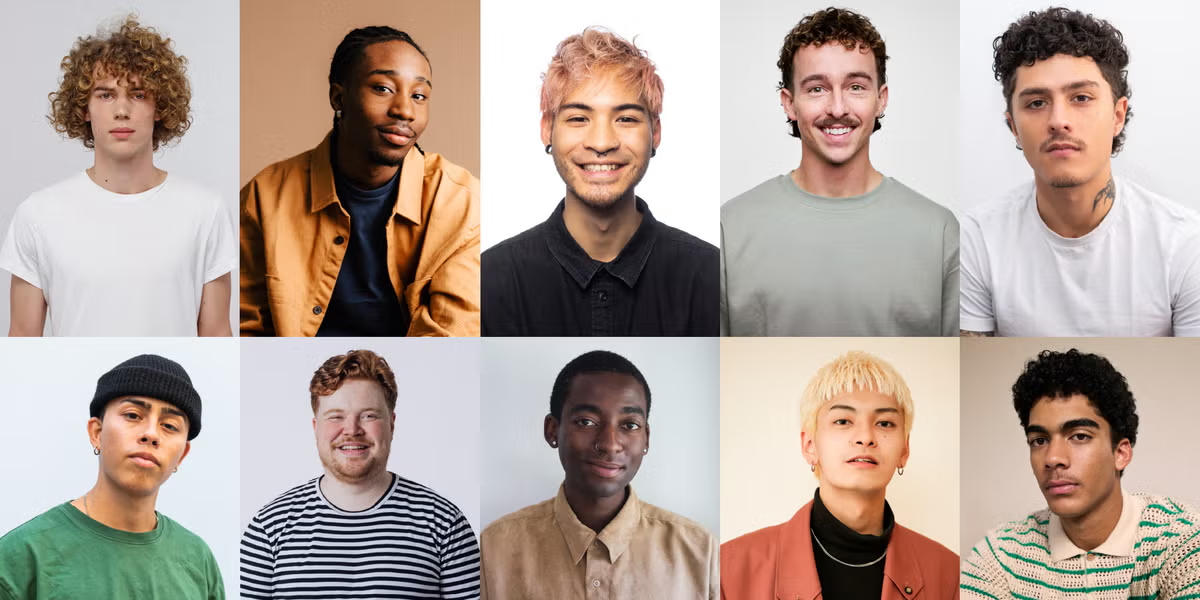
What do men really think of dating today? We asked 250 of them
It’s a rainy Friday in October and I’m standing outside the University of Leeds, wondering whether to chase after the 20-something man who’s running away from me. He’s one of many men who’ve been afraid of me today. Most of the others have glanced over, then averted their eyes, but this guy is like a spooked horse. After a split-second of contemplation, I decide it wouldn’t be wise to pursue a stranger; instead I limply shout after him, “But are you single?!”
It might seem bizarre to be loitering around a uni campus scaring men (okay, it is), but there is a method to this madness. I’m here with my colleague Catriona, who’s holding the sign that first attracted my runaway: ‘Single men! What do you really think of the dating scene? Tell us!’
As Cosmopolitan’s Sex and Relationships Editor, I spend a lot of time speaking to women about their romantic lives and, from what I hear, it’s rough out there. And while not everyone hates dating (some of you love it), the situation seems to be particularly dire for women and gender non-conforming people who date men. This is mostly anecdotal, seen in group chats, via social media screenshots of men who think women’s rights have gone ‘too far’, and through stories about partners who treat women as a parent or therapist. It’s found in the creation of whisper network groups on Facebook, where women cautiously post the profile pics of men they’re chatting to, to see how he’s treated others before.
But it takes two to tango, right? So why don’t we hear much from the men we’re dating? And this is what led us here, battling with our giant sign in the wind, as part of a two- month project to get into the minds of men. We wanted their opinions on the apps, whether they ghost/breadcrumb/[insert other dating buzzword here], how often their first dates turn into seconds, and, crucially, whether they’re as unhappy about their dating lives as the women who date them seem to be. In total, we spoke to 250 men (online and off ) — and this is what we learned.
Men on… dating apps
Mark* is, in his own words, “a firmly average man”. Yet, in spite of this belief, he says he’s “done better on the apps than he thought he would”, after joining them eight months ago. I find Mark, who’s 28 and from London, on Reddit, where he’d recently shared his fledgling app experiences with r/UKrelationshipadvice — not necessarily for advice, but more to show other people what dating is like today for ‘average’ guys like him.
To get a broad picture about young single men’s dating lives, we wanted to ensure we met as diverse a group of them as possible. And so, as well as hitting the streets of Leeds, we conducted one-on-one interviews and launched an anonymous online survey (where, we hoped, men could say the things they wouldn’t be willing to say to our faces).
Everyone’s clicking on…
Inevitably, many of those conversations revolved around dating apps. Because, although dating app use is declining (apps including Tinder and Bumble lost hundreds of thousands of users between May 2023 and 2025, according to Ofcom’s Online Nation 2025 report), they’re still where many of us go to meet people, with approximately 5.3 million UK adults using online dating services, also per Ofcom’s 2025 report. Interestingly, men make up the majority of users (68%), increasing from 3.2 million in May 2024 to 3.6 million in May 2025. Meanwhile, female users dropped during that time to just 1.7 million.

And, although they get a bad rap, dating apps aren’t all bad. For certain groups — LGBTQ+ people, those who work ‘anti-social’ hours, single parents, disabled people, the list goes on — they’re a really useful tool. Still, they are changing the way we date, interact with, and even perceive each other — not always for the better. By design, dating apps encourage people to champion appearance over everything else, and do it without nuance; each person is a ‘yes’ or ‘no’ based on a handful of photos and prompts, leaving no room for ‘maybe… once I get to know you’.
“I like that the apps can be fun and weird,” says Mark, “and there’s genuine joy to be had in matching, talking, and eventually meeting with people IRL. It also exposes you to a broad range of people you may never meet in your day-to-day life.” So far, Mark’s been on nine first dates in eight months, all of which led to second or even third dates. “I haven’t met anyone I have a connection with yet.” He does caveat all of this by acknowledging that he hasn’t been on dating apps for a particularly long time. “I can see how they’d become draining the longer time goes on, especially if you’re not connecting with anyone,” he says. “They’re low stakes to use, but at the same time they can carry so much weight. If someone creates a profile and doesn’t receive any likes or much traction, then that can be damaging. Personally, sometimes they make me feel good about myself, but other times they make me feel incredibly low.”
There’s a marked difference between those we speak to in real life versus those who answered our survey, as to how dating impacts the way they view themselves. Those we meet out and about tend to not be on the apps, instead meeting those they date in real life, while the respondents online said they’re mostly dating via the apps. This figures: those confident enough to come up to two women holding a huge sign (which one man admitted was “intimidating”) are likely to be more comfortable with chatting people up in real life. Still, it seems as though being on the apps, particularly for a long time, has resulted in men feeling trapped in a vicious circle: the apps make them feel worse about themselves, which, in turn, leaves them feeling like the digital world is the only place anyone might show any interest in them.
When asked why their confidence is impacted, our survey respondents said apps make it feel like dating is all looks-based, which has, for some, made them “feel ugly”. Some said apps make it feel like women aren’t looking for “the average Joe” and only want “good-looking white men over six foot tall and earning six figures”. Others said they don’t get many, if any, matches and rarely get responses to messages, which impacts their sense of self-worth and makes them feel like there’s “something wrong” with them. But hasn’t dating always been brutal? Would having to – gulp – go up and speak to someone we fancy, face to face, be any better? Isn’t rejection better felt through the safety of our blue screens?

“People use dating apps when they want little boosts of self-esteem,” says Luke Brunning, co-founder of the University of Leeds’ Centre for Love, Sex, and Relationships, and a lecturer in applied and inter-disciplinary ethics at the university’s Idea Centre. “It feels good when someone matches with you, right? But the problem is that matching has no meaning any more. When you match with someone, you don’t know if it’s because they’re swiping right on everyone or when they’re not looking at their phone, or because they’re drunk or bored and gave their phone to a friend. And so that’s a reason dating apps are becoming harder [and more miserable] to use, because the thing that’s meant to be an indicator of interest — however minimal — isn’t even that any more, and so often doesn’t go anywhere.”
Then there’s the online world that we live within: filters, editing tools, and what Brunning calls “the Love Island-ification of society” have warped our idea of what people really look like — case in point: young men on social media calling Margot Robbie ‘mid’ — and what we’re really attracted to. “People experience a disconnect between the things they actually like and the people around them that they’re into, and then what they’re told is attractive,” says Brunning. In short, if men are living the majority of their lives online, then they may think they only want to swipe on those who meet the conventional beauty standard, when in reality, those they would be attracted to, outside of their phones, may look entirely different from this. (For what it’s worth, our survey showed that looks are only part of the equation. When asked what makes men most want to match with someone on an app, 24% said if their profile is funny or interesting, 24% said looks, and 18% said if someone seems to have similar hobbies or interests as them.)
“The best relationships are the most authentic ones,” says 30-year-old Devon*, who we meet in Leeds, “and that happens when you match on values. People have become accustomed to apps and instant gratification, but we need to get out of our comfort zones. If we lowered the stakes and just chatted like we are now, it would be easier and happier.” But then… we meet Devon on campus, where there are plenty of opportunities to meet a variety of people naturally, from lectures to social groups to uni events. Once we leave school or graduate from university, the options become more limited.
“I’d love to meet people in real life, but there’s a lack of third spaces [to meet them in],” says 28-year-old Toby* from London (who I also find in the relationship advice subreddit). “Most of my hobbies are male-dominated, which makes it harder.” Toby did try speed dating once — which, along with other organised IRL dating events, has gained popularity since the pandemic — but says he’ll never go again. The night wasn’t bad per se, but he says that some people cancelled last minute, so there ended up being less women than men, and most of them were older (mid-30s versus mid-20s). “They were all in different stages of life to us,” he says, adding that he ended up bonding with the men more. “If the aim of the event was to meet new ‘bros’, then it did very well.”
So, if not online, then where? When was the last time you were chatted up? And how did you feel about it? As, amid all of these conversations, the voices of the many women I’ve spoken to (Cosmopolitan readers and my friends alike) ring in my head. We’re catcalled, labelled ‘prudes’ or ‘sluts’ online, and even sexually harassed on LinkedIn — the more stories I hear, the more I understand those going ‘boy sober’ and giving up on dating altogether. Chatting to men and hearing their insecurities, I do really feel for them — but I’m also well aware that, to generalise an entire gender for one sec (sorry, men), they’re far from the innocent party.

Men on… dating stereotypes
As the campus began to fill up with people darting to and from lectures, women meandered over to hear about our research. Some were genuinely curious, while for others the sentiment was very much, ‘Good luck with that’, and, ‘Why don’t you ask them why they’re all shit?’
Men, in general, are not thought of favourably by women; and, many would say, with good reason. We’ve seen the manosphere and incel ideology gain traction among a generation of extremely online men who, in the absence of positive male role models and amid confusion over their role in society, find themselves drawn in by the misogynistic rhetoric of men’s rights figureheads such as Andrew Tate and Jordan Peterson. There’s a growing backlash against feminism (according to a global 2025 study, carried out by Ipsos UK and the Global Institute for Women’s Leadership at King’s College London, 57% of Gen Z men believe we’ve gone so far in promoting women’s equality that we’re now discriminating against men). This all seeps into our dating lives. According to a 2020 Pew Research Centre study, 57% of women have received an unsolicited explicit text or image on dating apps, while 44% have been called an offensive name, and 19% have been threatened with physical harm, all typically from men.
All of this contributes to a divide between young men and women, who are increasingly critical of each other online, whose ideology gap is widening (as per British Election Study data analysed by the Financial Times, women are currently 25 percentage points more liberal than their male counterparts) and who don’t really seem to like each other — let alone want to date each other. Heterofatalism, AKA a feeling of disillusionment about heterosexual relationships, dominates on social media and there even seems to be a reluctance to be friends with heterosexual people of the opposite gender. In June 2025, Emily Ratajkowski told Elle that she’s refusing to “centre men” and has “zero straight men in her life, unless they’re a romantic interest”— a statement that was widely praised by most women online.
How did we get here? It’s like we’re back in the school disco, standing on opposite sides of the hall, not talking. Only this time we’re jaded and casting judgements on each other, as both men and women seem to feel as if they have it hardest. “There’s this technologically driven segregation happening,” says Brunning, “and it’s changing how we approach dating. Men and women don’t have to date together any more — they can do it separately, privately, and alone [in their flats with their phones]. And so they’re not hanging out [in non-date settings], which means they’re drifting apart.”

Many men are convinced they’re being persecuted by dating apps and the manosphere’s ‘80/20 rule’, which posits that 80% of women are attracted to only 20% of men — something 28% of Gen Z and 33% of millennial men believe in, as per a 2025 YouGov survey. Women, meanwhile, are supposedly stuck with a choice of toxic archetypes: the fuckboy, softboy, ‘nice’ guy, and the performative male, all of which suggest an epidemic of aloof, entitled, inauthentic men who manipulate women into relationships in one way or another only to refuse to commit and then, probably, ghost them.
“Women often tell me that the men they’re dating are ill-equipped when it comes to communicating with them in an emotionally-intelligent way,” says psychotherapist Simon Jacobs. “A lot of the men I work with have become very isolated and their friendships aren’t particularly emotionally supportive. But you can’t develop emotional intelligence on your own. You need to be in the room with people; you need to find and use that empathy muscle. And you can’t do that if you’re only communicating through your phone.”
The many rules, restrictions, and lockdowns throughout 2020 to 2022 have undoubtedly had a major influence on this sense of isolation — not just for men, but for everyone. “The pandemic pushed this generation online and prevented them from socialising at a crucial moment,” agrees Brunning. “So it’s not just about a lack of skills, but a lack of confidence in using those skills.”
So, are we helping matters by constantly telling men that they’re shit? The frustration is entirely understandable, but when we asked how they think they’re portrayed, respondents said it’s assumed they only want sex and casual relationships; that everything is always their fault; and that they’re ‘creepy aggressors’, domestically incompetent, and emotionally unaware and distant. Many men acknowledged that, as one put it, “there are a lot of pretty bad guys out there, so our negative portrayal isn’t unwarranted, but it also isn’t a completely accurate one of all of us”.
Those I interviewed felt similarly. “Men are quite often portrayed as villains and this isn’t fair,” says Mark. “There’s no smoke without fire, but it can’t be that half the population are truly awful. Men take a lot of the flak for the state of modern dating, but really men and women are both causing and experiencing suffering in equal measure, albeit in different ways. There needs to be accountability on both sides and less attacking each other.” It very much feels like the fun has been taken out of dating. So how can we get it back again?

Men on… how to improve dating for everyone
When we asked one student about his worst date, he recalled dinner with a girl who turned up late, was rude, and when the bill came, she wordlessly slid it across to him. “It wasn’t that I minded paying,” he recounts. “It was just the sheer expectation that I absolutely would that put me off.”
If we can accept that men are falling into toxic masculine roles (it’s not quite as simple as this, but: if they’re told that part of being ‘a man’ is to behave badly, then they will), can we also examine ourselves and see how our own socialisation impacts the way that we treat people? How many of us have overlooked guys that initially seemed awkward or dull in favour of a more charismatic, banter-spouting match who, it turns out, is only looking for fun, or an enigmatic option so enigmatic, they never reply? Online, particularly on social media, we’re seeing a worrying return to archaic gender norms, as evidenced by the rise of ‘tradwives’, but also videos offering advice for ‘future tradwives’ and the popularisation of ‘hypergamy’ — the practice of dating or marrying a partner of a higher social status – and the idea that men should pay on dates.
Then there’s the fact that some dating apps let us filter men out based on superficial things such as height. “It has become this cultural bellwether of attractiveness, and so there’s now a particular line of value — the six-feet line — which people claim they’re over, simply because they think they’re being filtered out if they’re not,” says Brunning.

It all points to one solution: taking ourselves offline to actually go out into the world and meet each other (as one student put it: “Nothing will happen if you don’t go out and do stuff”). But with confidence at rock bottom and the fear of looking ‘creepy’ (48% of men said they’d wouldn’t chat someone up in person for this reason), this is easier said than done. “I’ve attended a lot of social events alone,” says Toby. “So many people come in big groups and stay like that for the whole night. The fact is, it’s a lot harder for a single man to approach you when you’re surrounded by your friends.”
“To the credit of a lot of these young men, they want to be sensitive,” says Brunning. “They’re worried about seeming inappropriate, that they’re approaching people in the wrong way, or that they’ll be perceived as hostile, but that leaves them in this weird impasse where they acknowledge this online space isn’t really working for them, but they also don’t feel like there are any alternatives accessible to them. So we end up in a situation where everyone’s unhappy but no one feels empowered to change it.”
Brunning notes that we need a ‘de-escalation’ and to reduce the pressure on people; whether that’s the apps changing their designs to allow for an in-between — the ‘maybe… once I get to know you’ option — or all of us making a concerted effort to dissociate real dating from what we see on so-called ‘reality’ TV. The idea that dating is a constant competition that only a very specific (stereotypically ‘attractive’) type of person can win, by playing a very specific type of performative role, is toxic — and untrue.
“Dating is seen as something difficult and demanding, where you’ve got to put in work and excel at it, and only the attractive and extraordinary will do well and everyone else will struggle with,” Brunning continues. “So people think that’s the only way to present themselves: as sexually attractive, confident, strong, tall, and witty. In reality, young people are unsure — they’re hesitant, awkward, and don’t really know what they’re into. They’re figuring things out.”
When it comes to men specifically, Jacobs says there should be a concerted effort to challenge toxic ideas about what it means to be a man. “There needs to be a real emphasis placed on the importance of building emotional intelligence and getting [young men and women] to talk to each other respectfully and really listen,” he explains. “We still have a very archaic school system that focuses more on achievement than it does on building resilience through having a base of emotional awareness.”
At a micro level, we all need to simply hang out and actually talk more. While it’s impossible to extrapolate the conversations we had with single men in Leeds and online to the whole of the UK’s male population, what came up time and time again is that miscommunication and misconceptions between men and women are having a detrimental effect on all of our romantic lives (and beyond).

Whether we’re being polarised by the internet or radicalised — in both directions — by the terrible examples of masculinity we see the most (in world leaders and men’s rights influencers), we’ve fallen into a trap of black-and-white, gender essentialist thinking that pits us against each other and only serves to make us less understanding.
There are innumerable hurdles in the way of transforming our dating lives — most of which can’t be solved by individuals alone — but we can change our outlook. Instead of seeing each other as enemies, being reluctant to divert from a set of (arbitrary) standards, and being so afraid of failure that we don’t take risks, we could be inquisitive about one another’s experiences in the world. This doesn’t have to be done offline, but one of the best parts of our reporting was our in-person chats, where barriers were broken down and we could have candid back-and-forths — and, crucially, take the weight off the topic for a short while and actually laugh at the ridiculousness of how difficult dating has become.
I guess, if all else fails, we have at least found a foolproof way to find single men: stand outside and shout, ‘Are any of you boys single?’
*Names have been changed

Brit Dawson is Cosmopolitan UK’s Sex & Relationships Editor. Her work mostly delves into sexual subcultures, sex work, women’s rights, and sex and relationships, exploring how each intersects with technology, politics, and culture. Formerly a staff writer at Dazed and MEL Magazine, she’s written for British GQ, The Face, Slate, and more. She’s also interested in drugs, youth and pop culture, and books — so all the good stuff. Find Brit on Instagram, X, and LinkedIn.