100 Years of Documentary, Funding Cuts, Politics in CPH:DOX Focus
With funding cuts in the U.S. and European countries, other political challenges, and technological changes, what is the state of the documentary field? The Copenhagen International Documentary Festival (CPH:DOX) spotlighted on the challenges and the opportunities in a Wednesday afternoon session of its CPH:Conference industry program.
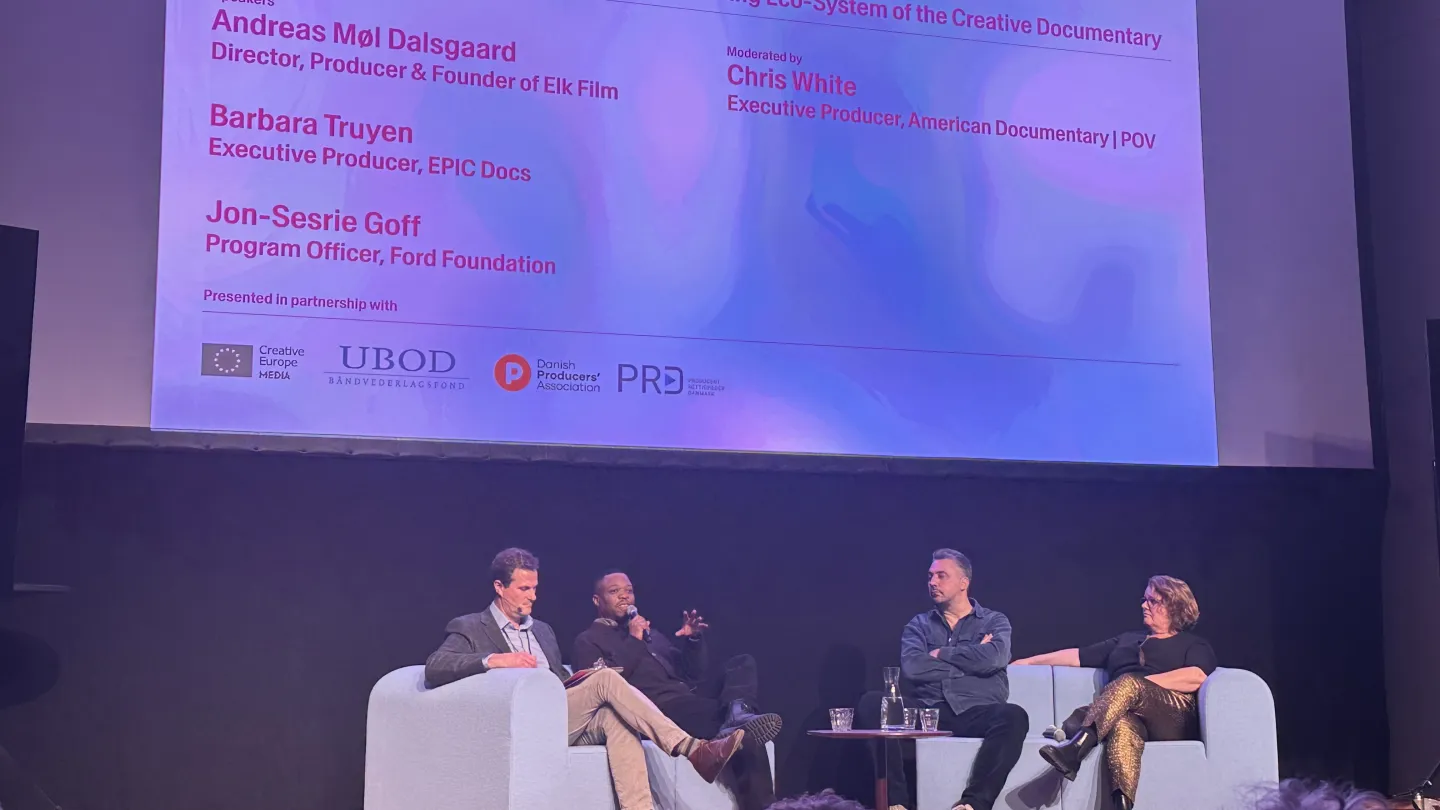
A panel entitled “Future Perspectives on the Shifting Eco-System of the Creative Documentary” brought together Danish doc director and producer Andreas Dalsgaard, who is the founder of Elk Film, Barbara Truyen, the former head of documentaries /commissioning editor for Dutch public broadcaster VPRO and now executive producer at her company EPIC-docs, and Jon-Sesrie Goff, part of the Creativity and Free Expression team at the Ford Foundation. The moderator was Chris White, executive producer at American Documentary l POV, who is responsible for producing PBS’ doc series POV and POV Shorts.
“There are 27 public broadcasters that are all members of the EBU [European Broadcasting Union, the alliance that produces the likes of the Eurovision Song Contest], and if we see each other in the documentary group, now we do group therapy,” shared Truyen. “We put down our phone, set down our laptop and really talk about what’s going on, and what we would need to do. We had never really felt the need to do that before, and now we do.”
Part of the reason is funding cuts. “If you go around Europe, for example, in the Netherlands, 20 percent of the budget is cut,” she explained. “So that means one out of five people lose their jobs, and one of five programs is not being made anymore. That’s huge, and that’s happening all around.”
White also highlighted U.S. funding cuts for public broadcasters under President Donald Trump. “In terms of the dollars that have left the field of independent documentary makers in the U.S., it’s around $40 million, and philanthropy can’t replace that,” highlighted Goff. “What has happened is not a budgetary loss, it’s a structural loss. A lot of us have oriented our careers and our practices around a model that no longer exists, and so we have to envision a new way of making and thinking about media and the public interest.”
Meanwhile, Dalsgaard mentioned political hurdles his team has been facing, explaining that ARTE Deutschland in Germany “doesn’t accept the Danish foreign ministry as a funder.” He explained: “There is a tendency in public broadcasting to start looking very carefully where the funding is coming from.” That is the case even if strict journalistic standards are being adhered to.”
Truyen highlighted the importance of broad-based European funding partnerships or networks of financing institutions for docs on the continent, pointing to this year’s documentary Oscar winner: “Mr. Nobody Against Putin winning the Oscar is amazing, but that’s really based on this European network.”
Truyen offered one idea to address current challenges: a broader rethinking of release windows and exclusivity. “It should be more about sharing, not so much about owning,” she suggested.
And how about some pride and celebration? “We as a field should be making a case for documentary,” urged Goff, referencing how filmmaker and critic John Grierson — often considered the father of British and Canadian documentary film — first coined the term “documentary” in 1926. “This is the centennial of documentary, and no one talks about it. It’s 100 years of documentary!”
He also drew laughter from the crowd when he shared: “I heard someone recently say [that] documentary isn’t sexy because it’s a tool, and tools aren’t sexy. Well, I think tools are sexy.”